
Tier 1
The book, signed, with ex libris
CHF 120 · €130
1×
Plus your name in the book’s list of supporters. With signature and ex libris by Osamu Okuda.
Limited to 300 places
Contribute · CHF 120
Karl Walser turns 150 in 2027. This book marks the anniversary: one place, a hundred and eighteen years apart, drawings and photographs side by side — made possible by its supporters.
1877 – 2027 · Published in spring 2027, the year of Karl Walser’s 150th birthday
Crowdfunding: help make this book happenContributions from CHF 120 / €130. Your contribution goes towards the production costs of the book; it is not the price of the book, which will later also be sold in bookshops.
Five tiers · Contributions until 31 January 2027 · Shipping included · By 31 October 2026: first in the list, low numbers
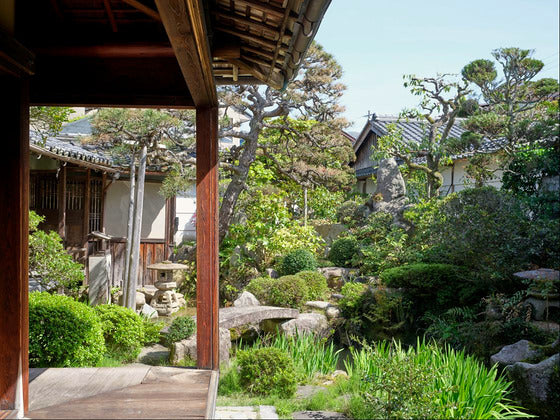
In 2026 Osamu Okuda and Dominique Uldry travelled to Miyazu as artists in residence, in the footsteps of Karl Walser, who was there in 1908. The journey has taken place; the places have been found and photographed. This book records what was seen and brings the project to its close. Your contribution helps to complete it.
In April 1908 Karl Walser and Bernhard Kellermann arrived by steamer in Miyazu, on Japan’s west coast. Walser drew, Kellermann wrote. The drawings survived, and so did the places — but the drawings gave no indication of where they were made. Noriko Matsuda has found the places again, Dominique Uldry has photographed them, the architect Madoka Hatano shows how Miyazu’s old houses are being renewed today, and Osamu Okuda, co-editor of the book, contributes the foreword. The book sets the drawings of 1908 beside the photographs of today, fully in English and Japanese. Its supporters make it possible.
In 2026 two museums devoted a major retrospective to Karl Walser: first the Tokyo Station Gallery (18 April to 21 June), then the Nakanoshima Museum of Art in Osaka (4 July to 27 September). Its title was “スイス絵画の異才 カール・ヴァルザー”, roughly “An exceptional talent of Swiss painting: Karl Walser”. Some 150 works were shown, all of them for the first time in Japan. According to the organisers, 72,728 people visited and 5,477 catalogues were sold. The exhibition was accompanied by the catalogue “Karl Walser. Retrospektive in Japan”, 360 pages in English and Japanese, with a foreword by Akira Tomita, director of the Tokyo Station Gallery; according to the Robert Walser-Zentrum it is already in its second printing. On 9 August 2026 the Nakanoshima Museum devoted a symposium to Walser, attended by some 200 people according to the Robert Walser-Zentrum. For a painter who was barely known in Japan before, this is a remarkable success. The interest is there, and 2027 brings his 150th birthday. Now is the moment for this book.
This anniversary book will be published because many people are funding it together. Your contribution goes towards the production of the book — printing, paper, binding and translation — and is not the price of a copy. As a thank-you you receive a copy of the first edition, signed by the editors, and your name in the list of supporters; from CHF 500 also a cliché print after Dominique Uldry, signed and numbered by hand by the photographer: the garden of the Mikami House that Karl Walser drew in 1908. Five tiers, each limited in number.
Plus your name in the book’s list of supporters. With signature and ex libris by Osamu Okuda.
 1×
1×
Plus your name in the list. Porcelain mug with Walser’s kokyu player.
Plus your name in the list. The print is signed and numbered by hand by Dominique Uldry; subject: the garden of the Mikami House.
Plus your name in the list. Large print, signed and numbered by hand by the photographer; subject: the garden of the Mikami House.
1×
 1×
1×
 2×
2×

Named as a benefactor in the book. Two large prints of the Mikami Garden, signed and numbered by hand by the photographer.
Shipping included · Withdraw at any time until the book goes to press · Pay in Swiss francs or euros, by credit card, in Switzerland also by TWINT · Contribute by 31 October 2026 for the low numbers.
| Tier 1 CHF 120 · €130 |
Tier 2 CHF 250 · €270 |
Tier 3 CHF 500 · €530 |
Tier 4 CHF 1200 · €1280 |
Tier 5 CHF 3500 · €3700 |
|
|---|---|---|---|---|---|
| First edition, signed by the editors | 1 | 1 | 1 | 2 one with dedication |
3 |
| Signature and ex libris by Osamu Okuda | ✓ | ✓ | ✓ | ✓ | ✓ |
| Name in the list of supporters | ✓ | ✓ | ✓ | ✓ | as benefactor |
| Porcelain mug, Walser’s kokyū player | – | 1 | 1 | 1 | 1 |
| T-shirt, Walser’s geisha of 1908 | – | – | – | 1 | 1 |
| Cliché print 40 × 30 cm, hand-signed and numbered Subject: garden of the Mikami House |
– | – | 1 | – | – |
| Cliché print 70 × 50 cm, hand-signed and numbered Subject: garden of the Mikami House |
– | – | – | 1 | 2 two hand-signed, numbered impressions |
| Conversation with the editors | – | – | – | – | ✓ |
| Original volumes Kellermann / Walser, 1912 and 1920* | – | – | – | – | first contribution |
| Places | 300 | 200 | 59 | 25 | 10 |

The original volumes. In 1908 the Berlin art dealer Paul Cassirer paid for his protégé Karl Walser to travel to Japan; the writer Bernhard Kellermann went with him, and on 24 April the two reached Miyazu. The journey produced two books, published by Cassirer and designed and illustrated by Walser: Kellermann’s travel account “Ein Spaziergang in Japan” (A Walk in Japan, first edition 1910) and “Sassa yo Yassa. Japanische Tänze” (Japanese Dances, first edition 1911), with collotypes and etchings after Walser’s studies. “Imagination and objectivity are firmly joined in Walser’s artistic physiognomy,” Hans Trog wrote in the Neue Zürcher Zeitung in 1909. The first contribution at benefactor level receives one copy of each: “Ein Spaziergang in Japan”, 1912 edition, 272 pages, half leather with gilt top edge, ownership stamp on the title page; “Sassa yo Yassa”, third edition 1920, with a colour frontispiece and eleven plates, three of them in colour.
Dominique Uldry has chosen one photograph for the supporters: the garden of the Mikami House — the same garden Karl Walser drew in 1908. It is printed in landscape format on fine-art paper with a white margin; the photographer signs and numbers every print by hand and sends it himself.

The book will later also be available in bookshops. Your contribution goes towards the production costs and is not the price of the book; the signed supporters’ edition is available only here. You contribute directly to the publisher, not through a platform. You then receive access to the supporters’ page with an advance selection of images, a workshop report and the schedule. Payment is in Swiss francs or euros — the currency depends on the country of delivery — by credit card (Visa, Mastercard, American Express), in Switzerland also by TWINT. Shipping is included. The book is dispatched after publication in spring 2027; mugs, T-shirts and prints are sent beforehand. The full amount is due with your contribution. Contributions are not used until the book is passed for press: until it goes to press, you may withdraw at any time and reclaim the full amount. After that, the amount is committed to printing and the book is delivered after publication. Should the book not appear, your contribution will be refunded in full. Within fourteen days of contributing you may withdraw without giving reasons. The cliché print transfers ownership of the object, not reproduction rights. Further questions are answered on the FAQ page.
Funded by the Berlin art dealer and publisher Paul Cassirer, Karl Walser travelled to Japan with the writer Bernhard Kellermann. On 24 April 1908 the two reached Miyazu. They crossed the sandbar of Amanohashidate to see the sword dance at the Aoi festival; the ceremony was already over, and the dancers performed it a second time, privately, in the garden of a house.
The stay gave rise to Kellermann’s “Ein Spaziergang in Japan” and, a year later, to “Sassa yo Yassa. Japanische Tänze” with Walser’s plates. Walser’s drawings and watercolours, however, carried no place names — titles such as “Entrance to a Temple” or “House with Garden and Pond” do not say where they were made.
Here I spent the finest time of my stay in Japan. I should like to speak of this town as of a friend. Bernhard Kellermann, Ein Spaziergang in Japan, 1910
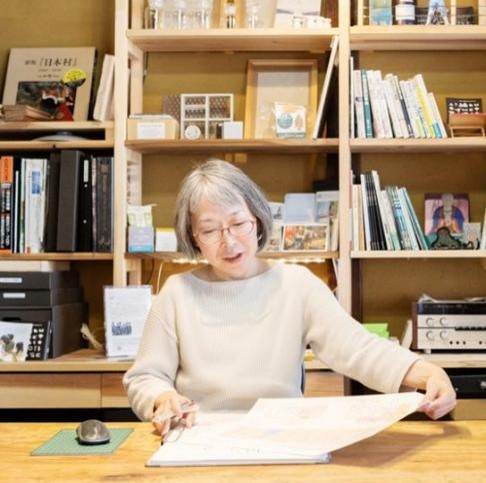
The foreword is by Osamu Okuda, art historian and co-editor of the book. He initiated the project, brought the contributors together and obtained archival material from Walser’s circle for the book. In his foreword he considers what the Japanese months meant for Walser’s work.
Okuda has worked in Switzerland since the early 1980s and knows both sides — the research in Bern and the places in Japan.
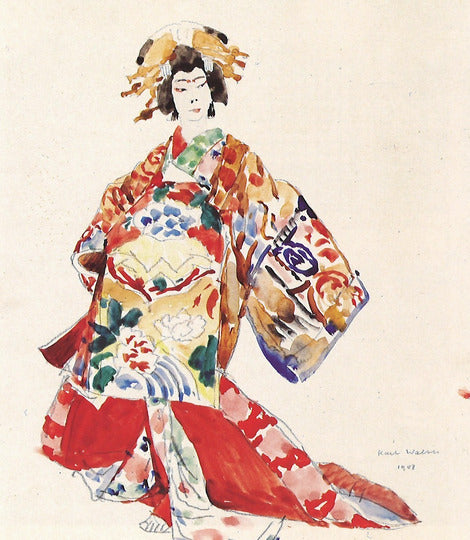
The main essay is by Noriko Matsuda, Associate Professor of architectural and urban history at Kyoto Prefectural University. Through fieldwork and historical photographs she established where Walser stood and matched the drawings to real places in Miyazu. She presented her findings at the Miyazu symposium on 30 August 2026; for the book she adds newly researched archival material.
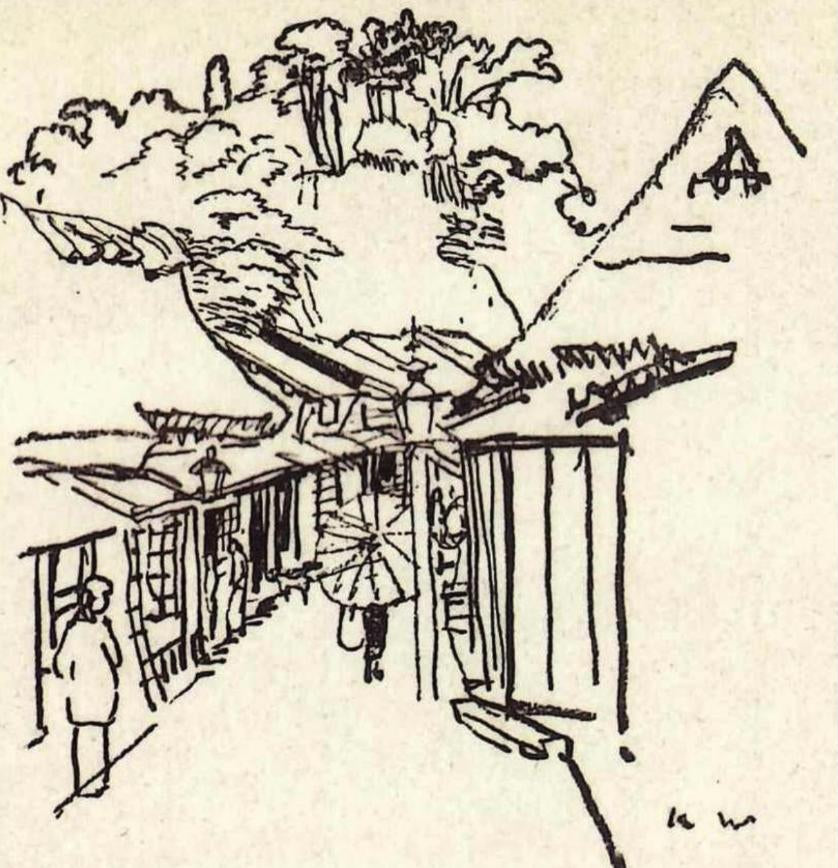
Her essay shows each identification as a pair: the drawing on the left, today’s photograph on the right. Both are shown with margins, because at this point both are evidence — not atmosphere, but proof. Where an identification is well founded but cannot be proven, the caption says so.

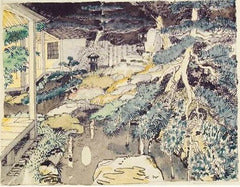

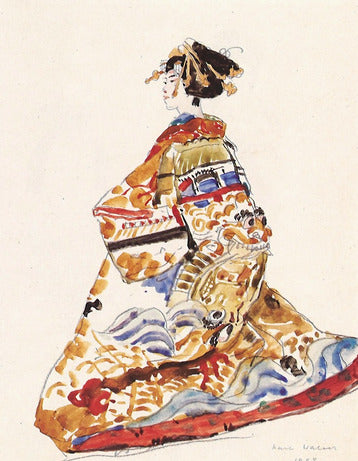
In the upper rooms of Miyazu’s teahouses Walser drew geishas again and again. These sheets cannot be tied to a place and therefore do not belong in the comparative section — in the book they form a group of their own alongside the drawings tied to places.
It is also the best-known group: the later paintings and the plates of “Sassa yo Yassa” grew out of it. In the book the sheets are shown with margins and visible paper edges, in a quiet sequence, with no text on the same page; the captions give technique, dimensions and owner, as far as these have been established.
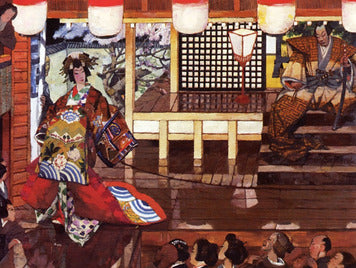
Next comes the photographic section by Dominique Uldry, a photographer based in Bern, introduced by an art-historical essay on photography. His pictures are not illustrations of Walser’s drawings but a second act of seeing, separated from the first by a hundred and eighteen years — and they insist on their own present: the parked car, the concrete wall, the cable strung across the sky.
In the book these photographs run full-bleed across the page, while Walser’s drawings are shown with margins. Turning the pages, you see the difference at once: one is evidence, the other is the present.
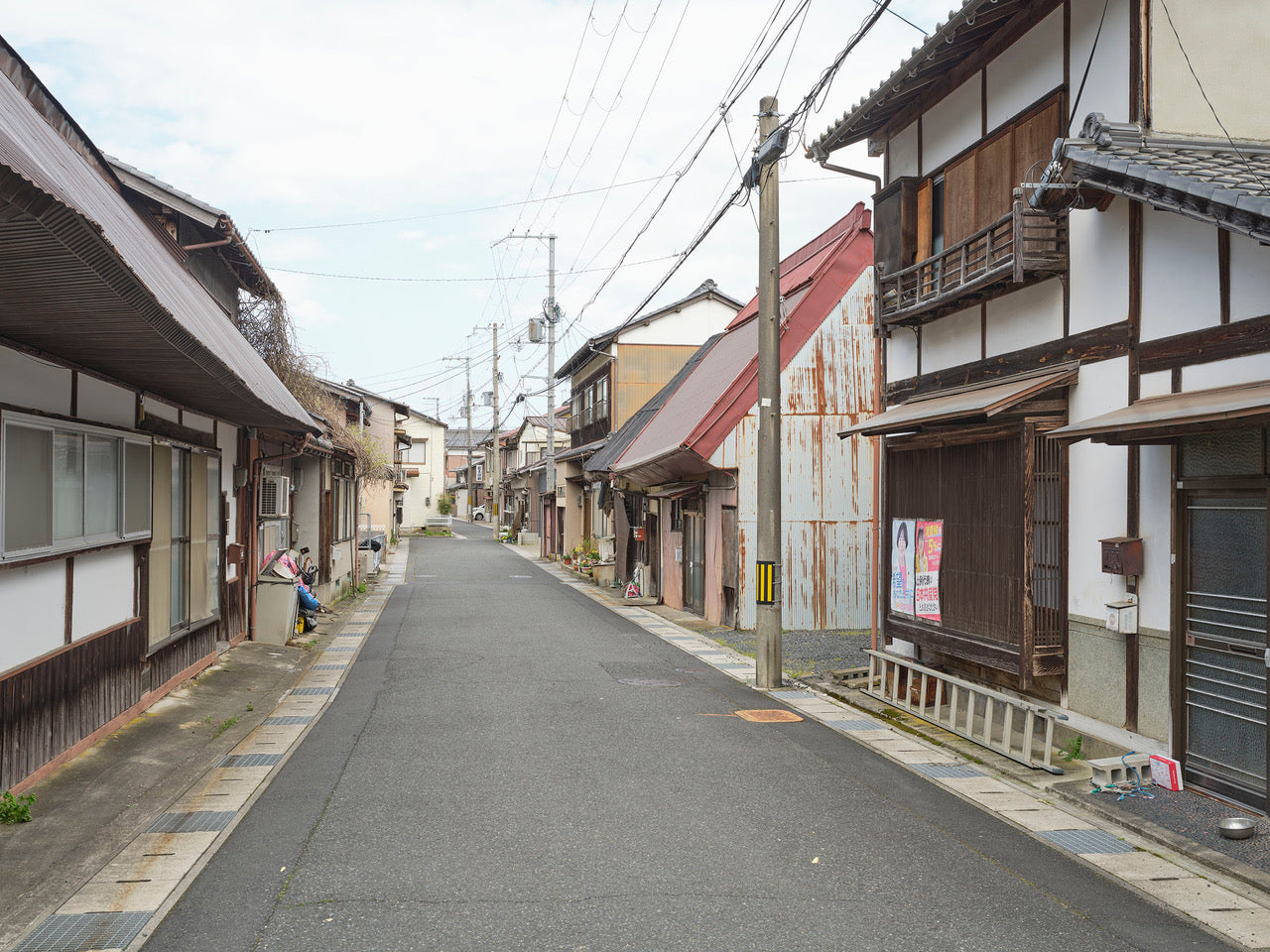
The photographs are followed by a picture essay by the architect Madoka Hatano. She has lived and built in Miyazu since 1998; with her network she restores the town’s old merchant houses, the machiya, and houses that had stood empty, and brings them back into use.
Among them is the “Chishiya”, the former residence of a kimono merchant, now a meeting place for local residents and visitors. Madoka Hatano is also involved in planning and running the artist-in-residence programme that began in Miyazu in spring 2026.
The last contribution is the book itself. Digiboo Verlag brought the collaboration about and will see it through to publication; the book is edited jointly by Osamu Okuda and the publisher.
The format is settled: a flat landscape 240 × 190 mm, 480 × 190 mm open — so that wide images become the rule rather than the exception. The book is fully bilingual: captions and short texts appear in English and Japanese beside each image, while the longer essays run in two separate language sections. An appendix lists picture credits and biographies and includes a chronology of the 1908 journey, with the return journey of 2026 alongside.

What is needed. Foundations, bookshop sales and the publisher’s own contribution cover part of the cost of production, translation and distribution; the crowdfunding, through the contributions of its supporters, covers the rest. There are five tiers, from CHF 120 to CHF 3500; each tier shows how many places remain when you order. Contributions are open until 31 January 2027, after which the book goes to press. Those who contribute by 31 October 2026 come first in the list of supporters and receive the low edition numbers of the cliché prints. Not yet decided? Sign up below and we will let you know when the selection of images is settled.
Art historian, born in Osaka in 1951, living in Switzerland since the early 1980s. From 1996 to 2004 research associate at the Paul Klee Foundation at the Kunstmuseum Bern, then at the Zentrum Paul Klee. His work includes “Paul Klee und der Ferne Osten. Vom Japonismus zu Zen” and the study “Die satirische Muse”. Co-founder of “Zwitscher-Maschine. Journal on Paul Klee”. He initiated the project.
Noriko Matsuda is Associate Professor at Kyoto Prefectural University, specialising in architectural and urban history. Her research addresses themes such as a “humanities history of the shoreline” – the zone between water and land. She has studied Miyazu since around 2005: the transformation of Amanohashidate into a seaside resort in the modern era, the history of the former pleasure quarters of Shinhama and Mannen-chō, and the cultural landscape of the townscape – and, in this context, the stay of Karl Walser and Bernhard Kellermann in Miyazu. In 2020 she was invited to ETH Zurich as an academic guest researcher to study traditional vernacular architecture, settlement landscapes and spatial configurations in the Swiss Alps. Her books, as author and co-author, include Ehagaki no Beppu (Beppu in Picture Postcards), Tōkyō mizube sanpo (Walks along Tokyo’s Waterfronts), Kiki to toshi (Crisis and the City), Sengo kūkanshi (A Spatial History of Postwar Japan) and Shibuya no himitsu (The Secrets of Shibuya). She presented her identifications of Walser’s drawings at the Miyazu symposium on 30 August 2026.
Photographer based in Bern. His work has long been devoted to architectural and art photography, alongside landscapes and non-places that he photographs without people. In 2003 the Kunsthalle Bern showed his work in its project space. With Bernhard Echte he produced the book “Seltsame Käuze, wir zwei. Karl und Robert Walser”. In Miyazu he photographed the places where Walser drew in 1908.
Architect in Miyazu. In 1998 she moved to Miyazu to design a prefectural park and set up her own practice there; in 2012 she founded Miyazu Machiya Revitalisation Network, which she has headed ever since. Besides designing new homes and shops, she revitalises machiya and vacant houses, mainly in the Tango area of northern Kyoto Prefecture — among them row houses more than a hundred years old and the “Chishiya”, the former residence of a kimono merchant, now hubs where residents and visitors meet. Since spring 2026 she has been involved in planning and running the artist-in-residence programme in Miyazu.
Publisher in Küsnacht on Lake Zurich, founded in 2011, with a list centred on art and cultural history, literature and the essay. For this book it is responsible for concept and design, typesetting, production, rights clearance, distribution and the crowdfunding.
Karl Walser’s work has been in the public domain since 2014. For the reproductions on this page, originals and permissions are being obtained from the owning institutions. The thank-you gifts use Walser’s kokyū plate from “Sassa yo Yassa” (1920), his drawing of a geisha in a kimono with shishi pattern (1908) and Dominique Uldry’s photograph of the garden of the Mikami House in Miyazu.
Every contribution helps to pay for the production, from CHF 120. Those who contribute by 31 October 2026 come first in the list of supporters and receive the low numbers of the cliché prints.
We write a few times a year, when there is something to report: when the selection of images is settled, when the book goes to press, when it is published.
Your address is used only for news about this book. Digiboo Verlag’s privacy policy applies.